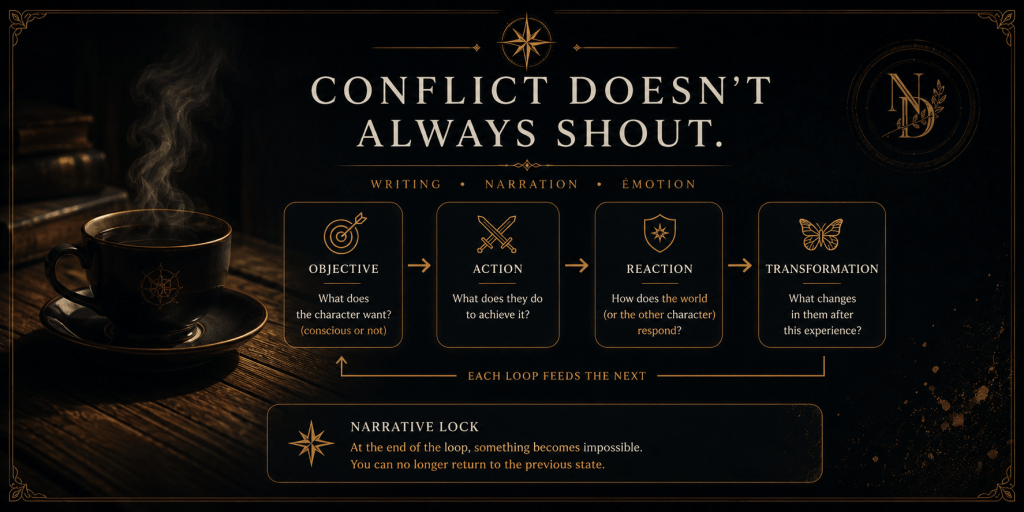
When people think about conflict in a story, they usually imagine arguments, confrontations, or direct clashes between characters.
Here, I want to focus on one of the most common forms of conflict: dynamic conflict between two people. But conflict can also be internal and much quieter — grief, fear, guilt, or the shock of a revelation someone never saw coming.
It’s also important to separate real conflict from false conflict.
A scene can look intense because characters are yelling, insulting each other, or violently arguing. But if nothing is truly at stake emotionally — or if the confrontation changes neither the characters nor the story — then the narrative often stays stuck in place.
Conflict doesn’t need to be loud or spectacular to exist. Even between two characters, it can take much more subtle forms.
Dynamic conflict is often portrayed as an explosion. Yet some of the most oppressive scenes are built on silence, emotional withdrawal, or a response that never comes. Because in reality, conflict is born from emotion.
Most of the time, that emotion stays contained beneath the surface. Sometimes it erupts into anger and noise. But more often, it becomes internal tension — expressed through a glance, an interrupted gesture, a colder tone of politeness, a stare that no longer looks away… or a sentence that sounds calm while quietly trapping someone inside it.
Conflict is deeply human because it comes from emotion. Behind an argument, a silence, or a confrontation, there is almost always fear, desire, frustration, vulnerability, or a truth someone can no longer keep buried.
That tension creates friction inside the story and pushes both the characters and the narrative forward.
Dramatic Oppression Doesn’t Always Come From Noise
Take The Silence of the Lambs.
Many scenes are calm. Controlled. Almost polite.
And yet:
the tension is unbearable.
Why?
Because:
- the pauses,
- the looks,
- the subtext,
- the psychological dominance,
- the silence,
- even the space between the characters…
create constant conflict.
Hannibal Lecter almost never raises his voice.
And still:
every scene with him feels like a duel.
Even:
- the way he speaks,
- breathes,
- watches Clarice,
- waits…
becomes conflict.
And The Shining works the same way.
For a huge part of the film:
the conflict is atmospheric.
It comes from:
- the empty spaces,
- the endless corridors,
- the isolation,
- the unease,
- the repetition,
- Jack’s stare,
- the silences,
- the slow emotional decay.
The final violence works precisely because:
the tension has been building slowly the entire time.
And honestly?
I think works like these stay with us because:
they understand the weight of the unspoken.
They understand that:
- waiting,
- discomfort,
- emotional control,
- and the absence of a normal reaction…
can feel far more oppressive than immediate violence.
And this connects directly to instinctive storytelling:
- a butler looking away,
- a character obeying too calmly,
- a hand left hanging in the air,
- someone going silent,
- someone quietly leaving the room.
These are:
silent conflicts — but emotionally devastating ones.
In the next article, I’ll go deeper into the tools used to build silent conflict: subtext, passive tension, verbal micro-violence, and emotional power dynamics.


Laisser un commentaire