the world’s rules rewrite every destiny.
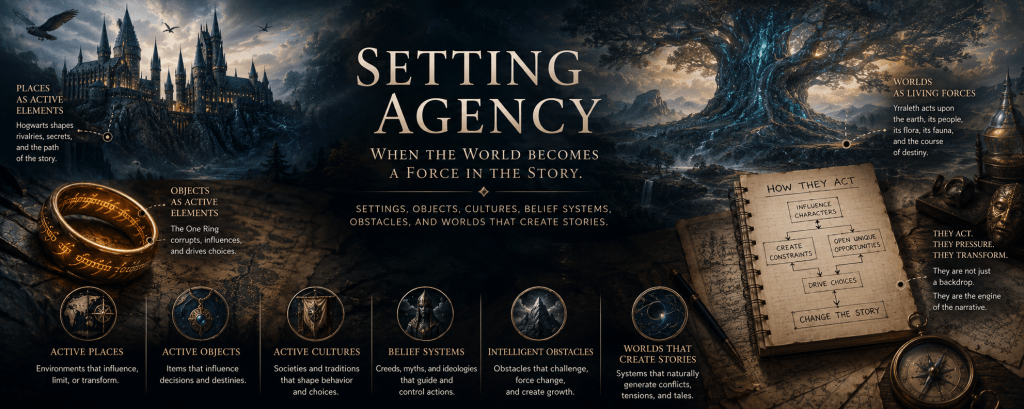
Do you think settings are only there to look pretty? What if they were actually mechanics that force characters to make choices?
I discovered that I had been using settings as a narrative tool without even realizing it.
For a long time, I thought a setting’s only purpose was to establish where the story takes place. That changed when I discovered Narrative Design (ND) and realized I had already been using settings as a way to put pressure on my characters.
In other words: I don’t simply describe places. I use them to move the story forward.
What Is Setting Agency?
Setting agency is the moment when a setting stops being a passive backdrop and becomes a narrative force. It influences characters, shapes their decisions, and alters the course of the plot.
An important distinction:
A setting can be important without being agentive.
A setting becomes agentive when the story changes—or breaks—if you replace it.
Let’s start with two well-known examples before looking at my own work.
Two Easy Examples
Harry Potter
Take Hogwarts. It contains ghosts, secret rooms, moving staircases, living portraits, and countless hidden mysteries.
If we removed Hogwarts as a magical boarding school, the constant proximity between students, the house system, and many of the story’s central conflicts would disappear.
The setting itself becomes an active participant in the narrative.
Harry Potter: without Hogwarts, there are no Houses → no structured rivalry, no secrets → no access to key stages of the story.
The Lord of the Rings
Consider the Mines of Moria.
The Fellowship is forced to alter its route and confront dangers that could not exist elsewhere. The location directly affects the characters’ decisions and the trajectory of the plot.
If Moria were replaced by a simple, obstacle-free passage, a significant part of the story would disappear.
The same principle applies to the One Ring, which corrupts those who carry it—especially the most vulnerable.
Agency is not limited to places.
The Ring is an example of an agentive object: it actively influences the characters and their decisions.
The Lord of the Rings: Moria = Gandalf’s fall and the fragmentation of the Fellowship.
In My Own Universe
In my universe, The Founders, Yrraleth represents a special case.
More than a setting, it acts upon Earth itself, its inhabitants, its fauna, and its flora.
A smaller-scale example can be found in Chapter 11 of Amor Puede Matar (The Roots of the World).
When Skeldan and Xianlian travel through the roots of the World Tree, each is affected differently.
They both lose their sense of time, but Skeldan loses his hearing, making him unaware of certain dangers. Meanwhile, Xianlian becomes overwhelmed by every sound around her, to the point of near madness, causing her to overlook threats in her environment.
A setting simply exists:
- Characters move through it.
- If it vanished tomorrow, the story would continue.
An agentive setting, on the other hand:
- creates constraints;
- opens unique possibilities;
- or triggers events.
Why Does Yrraleth Go Beyond Being a Setting?
Yrraleth is not merely a place where the story happens.
It is a force that makes things happen.
Its functions can be grouped into several categories:
Trigger
- Introduces magic into the world.
- Sets the events of Eve’s Chest in motion.
Archive / Reservoir
- Stores knowledge.
- Contains artifacts.
Sanctuary / Ecosystem
- Shelters the Syrbians.
- Influences Earth, its inhabitants, its fauna, and its flora.
Transformative Force
- Fragments itself during each Great Flood.
- Alters the sky.
- Shapes entire eras.
Force of Destiny
- Influences Freya’s destiny.
- Influences Idunn’s destiny.
In other words:
- The story changes if Yrraleth exists.
- The story changes if Yrraleth disappears.
Yrraleth is an active force within the narrative. It changes the trajectory of the world itself.
This pattern appears throughout my work:
- Naka cannot love whoever he wants. (Werewolf Cycle)
- Qitris cannot simply return home from war. (The Elmist Rift)
- Idunn cannot simply be reborn. (Eve’s Chest)
Because the rules, places, and forces of these worlds act upon the characters.
The Harder a Setting Is to Replace, the More Agentive It Becomes
Once a place:
- influences characters;
- alters decisions;
- creates obstacles;
- opens unique opportunities;
it gradually ceases to be a simple backdrop.
It becomes an active component of the narrative.
A Spectrum of Setting Agency
Setting agency exists on a spectrum:
Support Setting
It provides atmosphere, context, and flavor, but the story would largely survive without it.
Constraint Setting
It imposes costs, risks, rules, limitations, or obstacles.
Actor Setting
It triggers, redirects, corrupts, protects, reveals, or transforms. It actively changes the characters’ destinies.
System Setting
The setting no longer merely influences a story.
It defines the world’s underlying rules.
Examples:
- Yrraleth in The Founders
- The Matrix
- Spice in Dune
- The Zone in Stalker
At this stage, the setting becomes a narrative system in its own right.
Quick Test: Is My Setting Agentive?
Answer the following questions.
1. If I replace this place with another one, does my plot change?
- Yes, significantly → +2
- A little → +1
- No → 0
2. Does this setting create constraints for my characters?
Examples:
- hostile climate;
- unusual geography;
- social rules;
- local magic;
- architecture.
- Yes → +1
- No → 0
3. Does this setting offer opportunities that would not exist elsewhere?
Examples:
- secret passages;
- local traditions;
- supernatural phenomena;
- unique technologies.
- Yes → +1
- No → 0
4. Have the characters been shaped by this place?
Would they be the same people if they had grown up somewhere else?
- Yes → +2
- Partially → +1
- No → 0
5. Does the setting influence the characters’ decisions?
- Frequently → +2
- Occasionally → +1
- Never → 0
Results
A high score often means that your setting and your plot are deeply interconnected.
This can be powerful—but it also requires strong internal consistency.
0–2 points
➡️ Primarily functional setting.
3–5 points
➡️ Present but underused setting.
6–8 points
➡️ Strongly integrated setting.
9–10 points
➡️ Highly agentive setting, almost a character in its own right.
Exercise: Remove the Setting
Take an important scene from your story.
Then ask yourself:
- Can I move this scene to another city?
- Can I move it to another country?
- Can I move it to another world?
- Would the scene function exactly the same way?
If the answer is yes to everything:
your setting is probably interchangeable.
If the scene begins to break as soon as you change the location:
your setting already possesses some degree of agency.
Making a Setting More Agentive
Ask yourself:
- What does this place prevent?
- What does this place encourage?
- What values does this place promote?
- What behaviors does this place reward?
- What behaviors does this place punish?
- What would be lost if this place disappeared?
 La lanterne de l'ombre
Laisser un commentaire