Why do some writers rewrite very little… while others rewrite almost everything?
Beginning writers are often told that a first draft should be messy, fast, and imperfect. The advice is simple: keep moving forward, don’t look back, don’t chase the perfect sentence.
It’s good advice. In many cases, it helps writers finish a manuscript instead of spending years polishing the same chapters.
The problem begins when this advice is presented as a universal rule.
Over the past few days, my TikTok feed has been full of videos aimed at new writers, all explaining the right way to write a first draft. Those recommendations work well for many authors—but if I compare them to the way I write today, they’re almost the opposite of my own creative process.
I followed that advice myself for many years before realizing that, for me, it had become counterproductive.
Because creative processes are diverse, and a first draft doesn’t serve the same purpose for every writer.
1. The prevailing advice: write fast, edit later
The most common recommendation is to prepare your novel—your characters, settings, technical information if needed, and perhaps an outline if you’re an architect—then write your first draft straight through without worrying about quality.
The goal is simple: finish the manuscript.
Instead of spending years searching for the perfect sentence, endlessly rewriting the same scenes, or abandoning the project altogether, this approach encourages writers to keep moving.
The underlying idea is that a first draft doesn’t have to be good.
It simply has to exist.
The real work comes later during revision.
From this perspective, trying to perfect every paragraph while drafting is largely unnecessary because the manuscript will be rewritten anyway. In fact, for many writers, the revision stage lasts much longer than writing the first draft itself.
It’s a classic approach—and one that has helped countless authors.
2. Why this method works for so many writers
This approach makes perfect sense, and it genuinely helps many writers.
The problem only arises when it’s presented as the only valid way to write. For many authors, the first draft is primarily a tool for discovering the story.
Some writers begin with no outline—or very little—and leave plenty of room for intuition. They discover their characters, conflicts, scenes, and sometimes even the ending as they write.
Others already know the major turning points of the story—the beginning, key obstacles, climax, and ending—but leave everything in between open to inspiration. In that case, the first draft becomes a space for exploration.
For these writers, drafting quickly and accepting imperfection can be incredibly effective.
The rough manuscript becomes raw material. It reveals what works, what doesn’t, what needs to be moved, expanded, or removed.
I worked this way myself for more than ten years. I would spend about a month preparing, then roughly two months writing the first draft. After that came revision—a process that often took a year or more.
By the time the novel was published, the finished version often had very little in common with that original draft.
Eventually, however, I abandoned this method. For me, it had become counterproductive.
Why?
Because I mainly write long, interconnected series.
At some point, continuing this way became almost impossible. I was constantly afraid of contradicting myself. Even though I kept notes—and added new ones as I went—they were no longer enough.
I gradually lost the joy of writing because I had become disorganized and overwhelmed by my own fictional universe. I started procrastinating. Then came writer’s block. I couldn’t keep working like that.
So instead of forcing myself to write harder, I began analyzing what wasn’t working. Little by little, new planning tools emerged from those reflections.
What happened in the previous chapter?
What absolutely needs to happen in this one?
Where should the next chapter lead?
Those simple questions completely transformed both my preparation process and my relationship with writing.
3. A first draft doesn’t serve the same purpose for every writer
This is where the discussion becomes truly interesting.
Not every writer expects the same thing from a first draft.
For some, it’s a way of discovering the story. For others, it’s a way of testing a structure, a narrative voice, an atmosphere, or the dynamics between characters. And for others still, it’s primarily a way of putting into words a story that has already been carefully imagined long before the writing begins.
In that case, the first draft isn’t a rough sketch waiting to be completely rebuilt.
It’s already quite close to the final version—not because the writer gets everything right on the first try, but because most of the creative decisions have already been made beforehand.
These writers shift a large part of the work upstream.
They may spend months—or even years—building their world, developing their characters, designing their plotlines, weaving narrative threads, and refining the overall structure before writing a single chapter.
They already know what each chapter is meant to accomplish.
Their first draft isn’t about discovering the story. It’s about giving shape to a story that has already been deeply explored, analyzed, and structured.
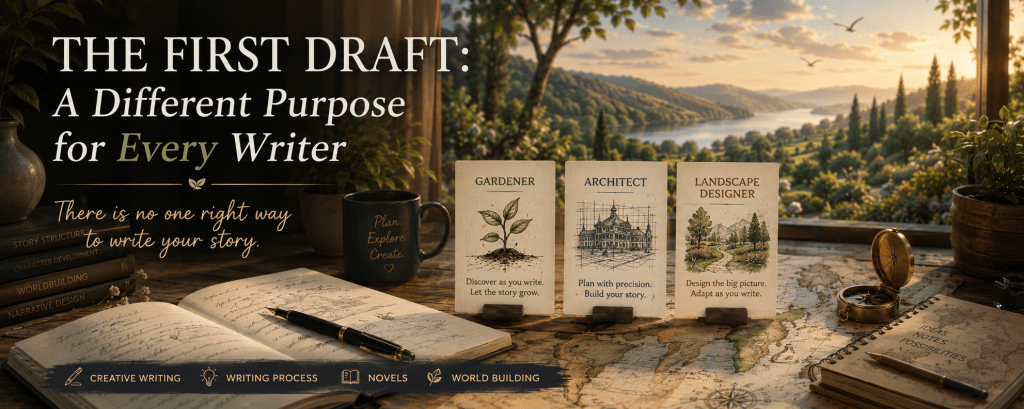
4. My journey: from Gardener to Architect… and finally Landscape Designer
Over time, I realized I belonged to this second family of writers.
But I certainly didn’t start there.
My process evolved through several stages:
- writing without an outline;
- using a loose outline (major goals, important events, scattered notes);
- creating detailed outlines (chapter summaries, worldbuilding, character files, and more);
- adding multiple layers of analysis (chapter analysis, setup and payoff, symbolism, exposition, dramatic function, etc.).
For me, preparation isn’t simply about knowing what will happen.
It’s about understanding why every scene exists, what it establishes, what it reveals, what it promises, and what it prepares for later.
I’m not just organizing events.
I need to understand each scene’s dramatic function—its role in the emotional, narrative, and symbolic progression of the story.
For years, I wondered whether I was a Gardener or an Architect. Eventually, I realized that neither description truly fit me. The image that resonates with me is that of a Landscape Designer.
A landscape designer doesn’t plant randomly. But neither do they freeze the landscape into something rigid.
They observe.
They compose.
They adjust.
They plan extensively while accepting that living things evolve—that unexpected shapes emerge, and that the terrain itself sometimes imposes its own constraints.
That’s how I now approach the first draft. I prepare extensively. But I still allow the story to evolve while I’m writing.
5. Finding your own method instead of copying someone else’s
For a long time, I believed that a first draft had a universal purpose. Today, I believe the opposite.
Its purpose depends entirely on the writer. For some, it is a tool for discovering the story. For others, it is a way of giving shape to a story they already know. Neither approach is superior.
They simply reflect different ways of thinking, imagining, and building a narrative. Perhaps the hardest part isn’t writing a first draft. Perhaps it’s understanding what role your first draft is meant to play in your own creative process.
 La lanterne de l'ombre
Laisser un commentaire