This article is for those who already write, but feel that their story still doesn’t quite hold together.
The Foundation: Structure
The Problem
We spend so much time writing, pouring our hearts into it. We reread our text over and over again, the sentences sound good, the style feels clean. We get feedback from beta readers or friends who give us their opinion on our “precious”…
We invest in a cover and we publish. And while we expect to hear “this is amazing” (I’m barely exaggerating), our book receives its first reviews… and we fall hard.
“The story lacks coherence.”
“It started well, but I lost interest.”
“I was disappointed by the ending.”
That’s if you’re lucky enough to get actual feedback… most of the time, you get one or two stars, and no real explanation of why your novel “failed.”
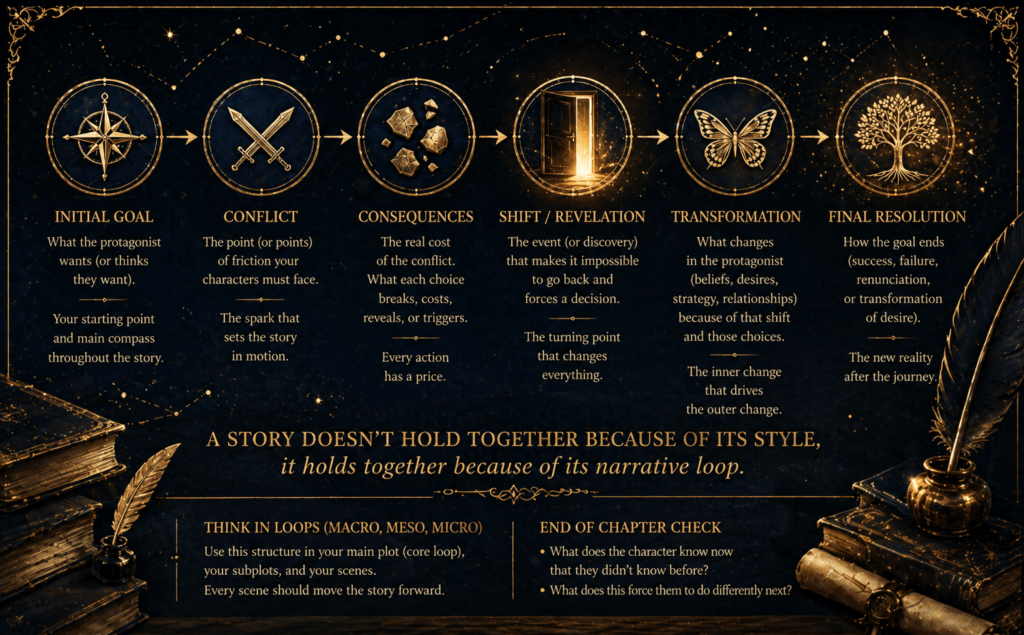
A story doesn’t hold together because of its style. It holds together because of its narrative loop.
I’m speaking from experience. For a long time, I felt that something was off, without being able to understand what — as if, despite working on the sentences, something just wouldn’t align.
Discovering Eva Deverell’s charts, and later K.M. Weiland’s analyses, allowed me to test different frameworks. After several unsuccessful attempts, I eventually built a structure that truly worked for me.
And that’s when I understood how powerful structure can be: it helped me break through many blocks and made my chapters much stronger.
A Simple Explanation
Most of the time, we’re told that a narrative loop looks like this:
setup → conflict → resolution
For me, this loop is incomplete. It leaves blind spots. It doesn’t address consequences — every action has a cost — or transformation, meaning how those consequences actually change things.
With these two elements, you can immediately see which characters remain unchanged from beginning to end — and that often reveals a real problem.
So I refined my loop:
Initial Goal → Conflict → Consequences → Shift/Revelation → Transformation → Resolution
- Initial Goal: what the protagonist wants (or thinks they want). This includes the starting situation, the conflict, and the final resolution. It’s your best compass to stay on track.
- Conflict: the point (or points) of friction your characters are confronted with.
- Consequences: the real cost of the conflict — what each choice breaks, costs, reveals, or triggers.
- Shift/Revelation: the moment (or discovery) that makes it impossible to go back and forces a decision.
- Transformation: what changes in the protagonist (beliefs, desires, strategy, relationships) because of that shift and those choices.
- Resolution: how the goal ultimately ends (success, failure, renunciation, or transformation of desire).
I keep this framework in mind at every level: macro, meso, and micro.
In other words:
- the main loop (the core loop),
- the secondary plotlines that connect to it,
- and the scenes that feed it.
A Common Trap
One of the biggest pitfalls is rushing to add revelations that don’t actually matter.
That’s why it’s essential to filter your ideas early on.
Two Questions to Ask at the End of a Chapter
To avoid overload or disconnected loops, ask yourself:
- What does the character know now that they didn’t know before?
- What does that force them to do differently next?
Conclusion
A story doesn’t fall apart because it’s badly written. It falls apart because it doesn’t hold together.
 La lanterne de l'ombre
Laisser un commentaire